A paragraph can contain a good idea, a relevant quotation and a correct citation, yet still feel unfinished. The usual problem is not a lack of research. It is that the writer has placed the evidence on the page without showing the reader what to do with it.
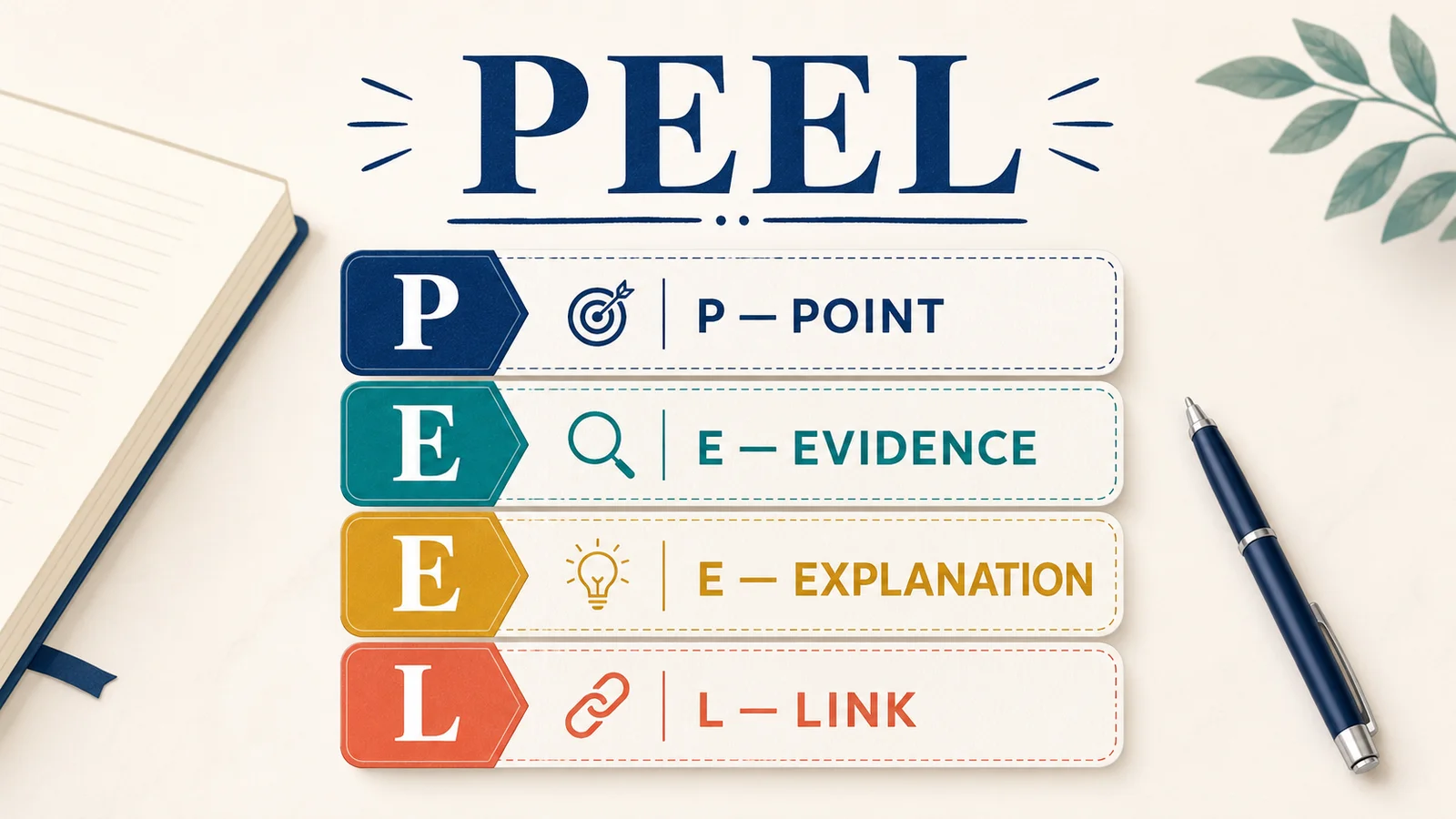
That is where the PEEL paragraph structure can help. PEEL stands for Point, Evidence, Explanation and Link. It is a simple way to check whether a paragraph makes a claim, supports it and connects it to the wider argument.
PEEL is not a rule that every paragraph must obey in exactly the same order. Think of it as a set of prompts. When a paragraph feels weak, the four letters help you spot what is missing.
What Does PEEL Mean?
Each part of PEEL has a different job:
| Part | What it does | A useful question |
|---|---|---|
| Point | Introduces the paragraph’s main claim | What am I trying to say? |
| Evidence | Gives the reader support for that claim | What can I use to back this up? |
| Explanation | Interprets the evidence | Why does this evidence matter? |
| Link | Connects the paragraph to the question or next idea | How does this move my answer forward? |
Several UK university writing guides teach these same building blocks. The wording sometimes changes—one guide may use “evaluation” where another uses “explanation”—but the underlying idea is consistent. A strong academic paragraph needs more than a fact followed by a reference.
Start With a Point Worth Developing
The point is the centre of the paragraph. It often appears in the first sentence, although it does not have to. Its job is to tell the reader which part of your argument you are about to develop.
Compare these two opening sentences:
Too broad: “Social media is important for students.”
More useful: “University societies can use social media to communicate event changes to students quickly.”
The first sentence could lead almost anywhere. The second gives the paragraph a clear direction and can be supported with evidence.
One practical test is to read only the first sentence of every body paragraph. Together, those sentences should form a rough outline of your argument. If two neighbouring paragraphs make the same point, they may need to be combined. If one paragraph introduces several unrelated claims, it probably needs to be split.
Choose Evidence That Actually Supports the Point
Evidence is the material that gives your claim weight. In an academic assignment, this may be a journal article, a book, a statistic, a theory, research data or a carefully chosen example. Reflective and professional assignments may also allow evidence from practice, provided the assignment brief permits it.
Do not choose a source simply because it uses the same words as your topic. Ask whether it is credible, current enough for the subject and genuinely relevant to the claim you are making.
Evidence also needs an introduction. A quotation dropped between two sentences can feel as though it belongs to somebody else’s argument. A lead-in can identify the source and keep the scope of its finding clear:
Graham et al. (2023) reviewed writing instruction for students in grades 6–12 and found a positive effect for text-structure instruction. This is evidence about a broader teaching approach, not a direct test showing that PEEL is better than other paragraph frameworks.
This paraphrase tells the reader where the finding came from and what it can support. The citation should then follow the style required by your university.
Explanation Is Where Your Thinking Becomes Visible
Many weak paragraphs have a point and evidence but very little explanation. The writer assumes the quotation or statistic is self-explanatory. Usually, it is not.
Explanation answers the reader’s unspoken questions: So what? Why is this relevant? What does it show? This is where you interpret the evidence, compare it with another view, identify a limitation or explain its implications.
The University of Hull’s paragraph guide describes analysis as the part where the writer shows why the evidence supports the point. That connection should be stated rather than left for the reader to infer.
Be careful not to stretch a source beyond what it proves. Research showing that structured writing instruction can help students does not prove that PEEL is the best framework for every subject. Acknowledging that limitation makes an argument more credible, not less.
A Link Should Do More Than Complete the Acronym
The final part of PEEL connects the paragraph to the assignment question, the main argument or the idea that follows. It does not always need to be the last sentence; sometimes the transition works better at the start of the next paragraph.
Avoid mechanical endings such as “This links back to the question.” The reader already knows that a link is intended. Tell them what the connection actually is:
Structured paragraph planning can therefore help students turn separate pieces of evidence into a connected argument.
That sentence draws a conclusion from the paragraph and prepares the reader for the next stage of the discussion.
A Complete PEEL Paragraph Example
Here is a paragraph about structured writing instruction. The labels are included so that each part is easy to see:
Point: Explicit writing strategies can help students organise academic arguments more clearly. Evidence: A 2023 meta-analysis involving 406 independent comparisons and 52,529 students reported positive effects from approaches that included strategy instruction, modelling, feedback and text-structure instruction (Graham et al. 2023). Explanation: The findings suggest that students benefit when the hidden steps involved in writing are made visible and practised. PEEL can act as one such scaffold because it prompts the writer to connect a claim with supporting material and analysis. However, the review examined broad writing interventions rather than PEEL itself, so it would be inaccurate to present the framework as a guaranteed solution. Link: PEEL is most useful as a flexible planning aid that writers gradually adapt as their confidence develops.
The evidence is taken from Graham et al.’s meta-analysis of writing treatments, published in the Journal of Educational Psychology. The worked paragraph illustrates how to organise an argument. The review involved school students, not a trial of university students using PEEL.
The explanation is longer than the point or link, and that is perfectly normal. Analysis often needs more space because it is doing the most demanding work.
How to Use PEEL Without Making Your Writing Robotic
Start with the framework while planning, not while trying to polish every sentence. Write your point, place the relevant evidence underneath it and add notes explaining why the evidence matters. Once the logic is clear, turn those notes into a natural paragraph.
Before finishing, remove the visible labels. You can also change the order when the argument calls for it. A paragraph might open with a surprising statistic before stating its main point, or it may use two pieces of evidence before reaching an evaluation.
The aim is not to produce four sentences of equal length. It is to make sure the reader can follow the movement from claim to support, from support to interpretation, and from interpretation to the wider answer.
PEEL and PETAL Are Similar, but Not Identical
PEEL is useful for general academic essays and analytical report sections. PETAL adds Technique and Analysis, making it especially helpful when discussing how a novelist, poet or speaker creates meaning.
| PEEL | PETAL |
|---|---|
| Point | Point |
| Evidence | Evidence |
| Explanation | Technique |
| Link | Analysis and Link |
For literary analysis, AcadFundu’s guide to the PETAL paragraph structure may be a better fit. For a general essay, PEEL is usually the simpler place to begin.
Five Problems to Look for While Editing
1. The evidence has been left to speak for itself. Add a sentence explaining what it shows and how it supports the claim.
2. The paragraph changes subject halfway through. Move the new idea into a separate paragraph unless it directly develops the original point.
3. The quotation is longer than the analysis. Keep only the words you need, then spend more space interpreting them.
4. Every paragraph follows an identical four-sentence pattern. PEEL is a checklist, not a mould. Vary the length and order when the argument requires it.
5. The link says nothing specific. Replace “This proves my point” with the actual conclusion or implication.
The University of Sunderland and University of Hull both present structured paragraphing as a foundation that can be adapted as a writer becomes more confident.
A Quick Check Before You Submit
Read each body paragraph and ask:
- Can I identify its main point in one sentence?
- Does the evidence genuinely support that point?
- Have I explained the evidence instead of merely inserting it?
- Is every borrowed idea referenced?
- Does the paragraph contribute to the assignment question?
- Does the transition to the next idea feel natural?
Your paragraphs also need to match the roadmap established at the beginning of the assignment. If the opening feels unclear, see How to Start a Report Introduction. When you reach the final section, the guide to writing an argumentative essay conclusion explains how to bring the argument together without simply repeating the introduction.
Frequently Asked Questions
What does PEEL stand for?
PEEL usually means Point, Evidence, Explanation and Link. Some teachers use Evaluation for the second E, particularly when they want students to assess the quality or limitations of evidence.
How long should a PEEL paragraph be?
There is no fixed length. The paragraph should be long enough to develop one point properly without drifting into a second topic. Complex evidence usually needs more explanation than a simple example.
Can PEEL be used in university assignments?
Yes. Several UK university study-skills services teach PEEL or a closely related structure. Follow your assignment brief first, then adapt the framework to the subject and level of study.
Does every paragraph need a link sentence?
Every paragraph should connect to the wider argument, but that connection does not always need a separate final sentence. It may be built into the analysis or placed at the start of the next paragraph.
What is the difference between PEEL and TEEL?
TEEL replaces “Point” with “Topic sentence”. In practice, both frameworks ask the writer to introduce an idea, support it, explain it and connect it to the rest of the assignment.
Final Thought
PEEL works best when it is almost invisible. The reader should not see a formula; they should simply encounter a paragraph that makes sense. Use the four letters to plan and diagnose your writing, then allow the final paragraph to sound natural.
References and Further Reading
- Anglia Ruskin University. Critical paragraphs: Academic writing.
- Graham, S., Kim, Y.-S., Cao, Y., Lee, J. W., Tate, T., Collins, P., Cho, M., Moon, Y., Chung, H. Q. and Olson, C. B. (2023) ‘A meta-analysis of writing treatments for students in grades 6–12’, Journal of Educational Psychology, 115(7), pp. 1004–1027. doi:10.1037/edu0000819. University record and abstract.
- Staffordshire University. Academic writing: PEEL paragraphs.
- University of Hull. Paragraph structure.
- University of Sunderland. Paragraphs: Study skills and academic writing.